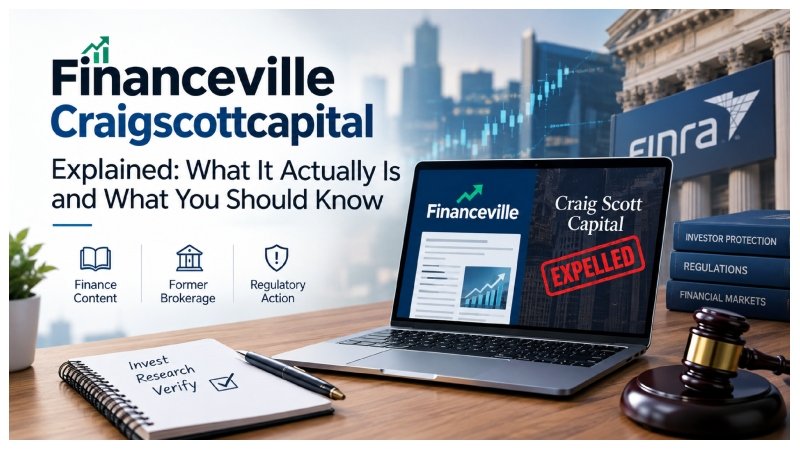
The phrase “Financeville Craigscottcapital” may sound like the name of a financial company, investment platform, or wealth-management service. However, the term does not refer to a single, established financial institution. Instead, it appears to combine the name Financeville, commonly associated with online finance content, with Craig Scott Capital, a former U.S. broker-dealer that faced significant regulatory action.
Understanding the difference between these two names is important, especially for anyone searching for investment information or considering a financial service found online.
What Is Financeville Craigscottcapital?
“Financeville Craigscottcapital” is essentially a combination of two separate names.
Financeville is generally used as a branding term for websites and online content covering subjects such as personal finance, investing, business, and financial markets. It should not automatically be interpreted as the name of a bank, licensed brokerage, or investment adviser.
Craig Scott Capital, on the other hand, was a real U.S. broker-dealer. The company operated for several years before being expelled from the securities industry following regulatory findings involving its business practices.
Because the two names are sometimes presented together online, readers may assume they represent one financial organization. Available information does not establish that they are the same company or that a current investment service exists under the combined name.
The History of Craig Scott Capital
Craig Scott Capital, LLC was a New York-based broker-dealer with CRD number 155924. The firm was established around 2010 and became a member of FINRA in 2012.
The company operated primarily in the retail brokerage sector and provided services involving securities trading and investment recommendations. Its headquarters were located in Uniondale, New York.
Craig Scott Taddonio served as the company’s CEO and majority owner, while Brent Morgan Porges served as its Chief Operating Officer and minority owner.
For a period, Craig Scott Capital operated as a relatively small brokerage serving individual investors. However, regulatory problems eventually became a major part of the firm’s history.
Regulatory Issues Involving Craig Scott Capital
One significant regulatory matter involved the handling of confidential customer information.
In 2016, the U.S. Securities and Exchange Commission (SEC) took action involving Craig Scott Capital and its principals. The case concerned, among other issues, the firm’s handling of sensitive customer information and its recordkeeping practices.
Regulators found that the firm had used personal email accounts to receive thousands of faxes containing confidential customer information. Some of these documents reportedly included Social Security numbers, account information, and identification documents.
The firm agreed to pay a $100,000 penalty, while Taddonio and Porges each paid $25,000 in penalties.
These events highlighted the importance of information-security controls and proper recordkeeping within financial firms.
Why Craig Scott Capital Was Expelled
The firm’s regulatory problems became more serious in 2017.
In September 2017, FINRA expelled Craig Scott Capital from the securities industry after findings involving excessive trading in customer accounts, inadequate supervision, and false or misleading statements to regulators.
Excessive trading, often referred to as churning, occurs when securities transactions are carried out at a level that is inconsistent with a customer’s investment objectives and can generate excessive commissions or costs.
According to the regulatory findings, brokers associated with Craig Scott Capital engaged in excessive trading in multiple customer accounts. The firm was also found to have failed in its supervisory responsibilities.
Following its expulsion from FINRA, Craig Scott Capital could no longer continue operating as a FINRA-member broker-dealer.
What Happened to People Associated With the Firm?
Regulatory consequences also affected individuals associated with Craig Scott Capital.
Craig Scott Taddonio and Brent Morgan Porges faced industry bars related to violations involving their responsibilities and supervisory conduct. Other individuals associated with the firm also faced disciplinary action.
These actions demonstrate that regulatory enforcement can extend beyond a financial company’s corporate entity and involve the individuals responsible for its operations and supervision.
Why Does the Name Still Appear Online?
Although Craig Scott Capital is no longer an operating broker-dealer, its name can still appear in online searches.
There are several possible reasons for this continued visibility.
First, the firm’s history provides an example frequently discussed in articles about brokerage regulation, investor protection, and financial misconduct.
Second, finance websites may reference historical companies when creating educational or informational content.
Third, some websites may combine older financial names with modern finance-related keywords to attract search traffic. This can make an old company appear connected to a newer financial brand when there may be no such relationship.
For this reason, readers should not assume that every website mentioning Craig Scott Capital is affiliated with the former brokerage.
Is Financeville Craigscottcapital a Current Investment Platform?
There is no established evidence that “Financeville Craigscottcapital” is the name of a currently licensed U.S. brokerage or investment firm.
The original Craig Scott Capital was expelled from the securities industry, while Financeville is generally encountered as a content or branding term rather than as a regulated brokerage.
This distinction is particularly important when an unfamiliar website claims to provide investment services. A website’s appearance, articles, logos, or professional language do not prove that it is licensed to handle investments.
Before sending money or personal documents to an unfamiliar financial service, investors should independently verify the company’s registration and disciplinary history through official regulatory resources.
How to Verify an Investment Company
Online research should go beyond reading articles or promotional pages.
Before using an investment platform, consider checking:
- Whether the company is registered with the appropriate financial regulator.
- The firm’s regulatory and disciplinary history.
- The identities and registrations of the people offering financial services.
- The company’s official business address and contact information.
- The fees and trading costs associated with the service.
- Whether the platform clearly explains how customer funds and information are handled.
In the United States, resources such as FINRA BrokerCheck and SEC databases can help investors investigate financial professionals and firms.
Lessons From the Craig Scott Capital Case
The history of Craig Scott Capital illustrates several broader issues that investors should understand.
Excessive Trading Can Increase Costs
Frequent trading can generate substantial commissions and other expenses. Investors should understand how trading activity affects their accounts rather than focusing only on potential returns.
Supervision Matters
A financial firm needs effective systems for monitoring employees and customer accounts. Regulatory enforcement can occur when firms fail to maintain appropriate supervisory controls.
Personal Information Requires Protection
Financial companies handle highly sensitive information. Proper security, recordkeeping, and privacy procedures are essential when dealing with customer documents.
Verify Before You Invest
A company’s website or online reputation should not be treated as proof of regulatory status. Independent verification is especially important when an unfamiliar company is requesting money or sensitive information.
Financeville vs. Craig Scott Capital
Although the names may appear together online, they should not automatically be treated as one organization.
| Name | General Description |
|---|---|
| Financeville | A term associated with online finance and business content |
| Craig Scott Capital | Former U.S. broker-dealer |
| Current Status of Craig Scott Capital | Expelled from the securities industry |
| Financeville Craigscottcapital | A combined search phrase rather than an established financial institution |
This distinction can help prevent confusion when researching the term.
Final Takeaway
Financeville Craigscottcapital is best understood as a combination of modern online finance-related branding and the historical name of Craig Scott Capital, a former U.S. broker-dealer.
Craig Scott Capital’s history includes significant regulatory actions, including findings related to customer information, recordkeeping, excessive trading, supervision, and regulatory compliance. The firm was ultimately expelled from the securities industry.
For anyone researching the combined term today, the most important step is to separate historical information from claims about current financial services. If a website or individual uses the name to offer investment opportunities, verify the relevant registration and regulatory information independently before providing money or personal documents.
When it comes to financial decisions, official regulatory records are generally more useful than promotional websites or search-engine descriptions.